Tuesday, April 27, 2010

Last Sunday's Sermon: Revelation 7:9-19

Revelation 7:9-19

On his ninth life and chasing Tweety Bird, Sylvester the Cat makes a fatal leap. Searching for Bugs Bunny in a dark room filled with dynamite, Yosemite Sam lights a match. Thinking he hears the Road Runner speeding around a curve, Wile E. Coyote leaps directly into the path of a bus. BAM!

The scene switches to a sky filled with harmless fluffy clouds. We encounter Sylvester, or Sam, or Wile E., rising softly into the sky, halo around their head, a harp in their hands, and an exasperated expression on their face. From the adventures of chasing and fighting to a life defined by puffy clouds and soft music – one gets the impression that life in heaven is some kind of a demotion.
That’s how it goes with popular conceptions of the beyond.

No wonder, in the old movie Heaven Can Wait Warren Beatty wants to leave heaven to play quarterback for the Rams. You know it’s an old movie because who wants to play for the Rams? Apparently, even that gig is better than heaven.
The same, unfortunately, goes for popular conceptions of worship. Just think of The Simpsons’ First Church of Springfield. If something spiritually significant were to happen, people wouldn’t know what to do. Staid formality. Droning sermons. Tired people, tired liturgy, tired music. Why would someone go through all that monotony when she could be cultivating a lovely vegetable garden? Does worship matter?

I

Could the church be part of the problem?

Time was, you’d find a nice emerging neighborhood, call a pastor, build a church, open the door and have a few hundred members before you know it. People would move to a city like Lancaster and immediately start looking for a Lutheran church, and they’d quickly find Holy Trinity.

Could it be, the church had it just a little too easy for awhile?

Could it be, the church became a little too ordinary?

Meanwhile, the Civil Rights Movement confronted us with the question of race. The sexual revolution emerged, and suddenly making love looked a lot more compelling than making felt boards for Sunday School classrooms. Vietnam, Watergate, and the Cold War, and let’s face it, 9/11 and health care reform. Oh, people came back to the church for a little while after 9/11, but what has the church had to say?
We’re not asking about whether churches provide meaningful worship. We’re not asking about quality. Holy Trinity has a long heritage of strong preaching and outstanding music with leaders who are talented, creative, and dedicated. So do other churches in our community. We’re asking about the broader church and how our worship interfaces with the world.

How did the message of the church reach the point where it was tame? How did the church become a safe place? How did the church lose its ability to command the attention of people facing radical changes in the economy, in technology, in family structures? In an age without a standard family structure, why do churches keep making pictures of mom, dad, and their two children?

I’m asking a hard question. But how did it come to be that Yosemite Sam with halo and harp came to represent our afterlife hope? How does it make sense to represent the First Church of Springfield as boring and irrelevant? How did the church become tame?

II

So heaven can wait. And worship can wait. But this morning a biblical text confronts us with both. Worship. In heaven.

There is something splendid, something glorious about this scene in Revelation. At a moment of great crisis in Revelation – earthquakes, cosmic portents, kings, merchants, and soldiers hiding from catastrophe – “Who can stand before the wrath of God?” they cry -- at this portentous moment things

slow

down.

And the focus shifts. From chaos to celebration. John sees a great crowd, countless even to Google, people from every nation, every tribe and people, speaking every language, a countless throng. They’re not playing harps, nor are they humming familiar hymns, they are shouting! “Salvation! Salvation belongs to God! Salvation comes from the Lamb!”

Glorious, but real. For this worshiping throng consists of people who have lived through the worst. They have lived their faith openly, they have risked family and reputation, body and life, they have followed the Lamb and now they serve him day and night.

Glory sometimes arrives smeared in the muck of conflict and injustice. Glory sometimes passes through ugliness. In 1963 Fannie Lou Hamer was helping organize people for voting rights in Mississippi. Pulled from a bus in the small town of Winona, she was taken to jail. Under state police supervision, she was beaten with a blackjack until her whole body swelled up hard. Vision impairment and kidney trouble from that beating would trouble her for the rest of her life. Dragged back to her cell, Fannie Lou Hamer began to worship. She sang out.

Paul and Silas was bound in jail – let my people go.
Had no money for to go their bail – let my people go.
Paul and Silas began to shout – let my people go.
Jail doors open and they walked out – let my people go.

Glorious worship in a small town jail cell. How does Revelation put it? These are they who have come out of the great ordeal; they have washed their robes and made them white in the blood of the Lamb. Not clean, not trouble-free but real, glorious worship. There’s something splendid about that.

III

Now imagine. Imagine Revelation’s first audience sitting in a room as this scene is read aloud. Little churches in major cities: Ephesus, and Smyrna, Pergamum and Thyatira, Sardis, Philadelphia, and Lacodicea. Small, vulnerable communities of faith in the major cities of their day. These people huddled in their dozens, worshiping in houses among their neighbors.

Imagine how this scene would strike them. A multitude around the throne and around the Lamb. Not dozens, but countless. Every nation, every tribe, every people, every language – a community so vast and rich that none of us have ever seen such.
Imagine these quiet little communities, how this sounds to them. Big worship. No soft church music; they’re raising the roof, lifting their voices: Salvation is God’s! Salvation belongs to the Lamb!

Imagine these people. They live with worship all around them. They walk down the streets and – literally – temples tower around them. Temples to Rome, temples to the emperors. Their cities petition the Roman Senate for the opportunity – the opportunity – to worship the emperor! Festivals and temples. Their leading citizens sponsor choirs – choirs in uniform to sing praise to the emperor. Praise to the emperor, who calls himself savior.

Imagine these Christians who risk treason. The one they name as Savior does not live in Rome. The choir they want to join does not sing praise to Caesar. Imagine these little communities, hearing this scene from Revelation read aloud – imagine worship as an act of loyalty and commitment. Imagine worship where worship is counter-cultural. Imagine.

IV

There it is. Our passage reveals two things about worship, and I’d like to reflect on them for awhile. There’s so much more to say about worship, but let’s stay with these two.

Our worship confesses our loyalty. Like our faith ancestors in Pergamum and Sardis, we confess our loyalty in worship. There is only one who merits our allegiance, the God of our Lord Jesus Christ, and only to God do we offer our worship.

The church has confessed its loyalty in dramatic moments, sometimes successfully and sometimes not. Back in 1960s Mississippi, a white seminarian named Ed King got the bright idea of taking mixed-race groups to worship at white churches. They were routinely turned away by cross-armed deacons– sorry, Deacon Mauro – at the church steps, determined to keep their communion tables all white. King asked one deacon, “Would Jesus turn people away from worship?” The deacon replied, “Leave Jesus out of this.” We don’t always get our loyalty just right.

Let us not be confused. Followers of Jesus have gathered to worship when governments have forbidden it. Roman Christians would go underground into the catacombs. Slaves in North America would “steal away” to secret brush arbor meetings. During the Nazi era, Christians held clandestine meetings in churches and homes. It goes on still, in the face of official and unofficial suppression.

It happens today, right here, in this moment. We love our country, but we do not pledge our allegiance to the flag in church. We may be proud of our jobs, but they do not bind our conscience. Neither nation, nor ideology, nor profession is worthy of our ultimate allegiance – for that, only God. Only God. Worship reminds us to keep everything else in its place. Worship voices our loyalty.

V

Worship shapes our identity. It reminds us – no, it makes us – who we are.
Back in 1986 or so one of my college professors invited me to lead worship with her. We went to Memphis’ First Congregational Church. The church was clearly dying; only a dozen or so people, all eligible for Medicare, were scattered around the old sanctuary. Quite the depressing scene

Ten years later my alma mater had invited me to join the faculty, and my family and I were seeking a church home in Memphis. Surprisingly, we were referred to First Congregational as a vibrant, thriving congregation. We visited, and we just fell in love with the place. About three hundred people, clearly in love with God and with one another, vibrant worship, music, and preaching. Not only a full-time pastor but a full-time associate pastor as well. The atmosphere was just celebratory.

What happened? Well, worship makes us who were are. Those courageous final members had called a new seminary graduate to pastor them, and they’d negotiated one deal. “Whatever it takes.” So this pastor said, “We’re gonna welcome everyone.” The church opened itself to gays, lesbians, and other sexual minorties – the only mainline congregation in a city of a million people to do so – and they came by the dozens, then the hundreds. Told all their lives that they were not worthy of the church, these people found themselves in worship as people God loves. And that church, about half gay, half straight, is still growing and flourishing.
Worship tells us who we are.
  • Our neighbors know us as the family with the perfect lawn – well, my neighbors don’t, but yours may. Worship names us as people chosen and loved by God.
  • At work, we’re the reliable employee. Here at Holy Trinity we begin worship by confessing our sins and rehearsing God’s saving love.
  • Our society divides us into liberal and conservative, white, black, Latino, or Asian; worship reminds us that we are all one in Christ Jesus.
  • Our culture values us as consumers, voters, demographics; our worship calls us to get out and bring mercy to our world: “Go forth and serve the Lord.” And we answer, say it with me, “Thanks be to God.”
Worship tells us that we are called, loved, redeemed, healed, sanctified, blessed, and sent. In a world that labels and marginalizes, assumes and categorizes, who are we in worship? Friends, we are followers of Jesus, called to bless the world.

HOME

Perhaps the worst thing someone could say about worship is that it is harmless. That it is tame. Worship matters. In a world where powerful forces turn us into commodities – bodies to work, consumers to purchase, demographics to research – worship names us as followers of the risen Christ. In a society committed to dividing us – liberals from conservatives, women from men, old from young, white people from people of color – worship identifies our true loyalty. Worship calls us beyond false identities and fading loyalties to the fierce, loving God – the fiercely loving God – revealed in Jesus Christ. “Blessing and glory and wisdom and thanksgiving and honor and power and might be to our God forever and ever!” Amen? “Amen."

Sunday, April 25, 2010

Yes, Virginia, It Is about Race: Decoding Conservative Racism

When Virginia's Republican governor, Bob McDonnell, recently endorsed a "Confederate History Month" for April, he initially neglected to mention slavery as a part of that Confederate legacy. Defending McDonnell against widespread criticism, Mississippi's governor Haley Barbour accused critics of making "a big deal of something that doesn't amount to diddly."

Thus the question: Why do political conservatives, particularly Republicans, tolerate and often endorse racism? The question requires a couple of clarifications. First, I am admittedly painting with a broad brush. Not all conservatives tolerate racism, but the movement as a whole does -- and we can analyze why. We should add that even those who despise racism but do not speak out against it are complicit because they benefit from its use (as we'll see).

Second, some will protest that there's nothing particularly racist about conservative politics, particularly the Tea Party movement. Unfortunately for that argument, we're now facing hard data that demonstrates the role of race in the Tea Party movement. For example, separate polls from the University of Washington and CBS News/The New York Times demonstrate that Tea Partiers hold opinions on race-related issues that differ widely from the general public. Thus, people who believe "that blacks don't try hard enough, use slavery as an excuse, and ... have received more than they deserve" are 37 percent more likely to join the Tea Party than are the rest of the population (Leonard Pitts, quoting Christopher Parker of the University of Washington). In the UW study (according to Diversity Inc), among white Tea Partiers 35 percent perceive blacks as hard-working, 45 percent see blacks as intelligent, and 41 percent view blacks as trustworthy. As fivethirtyeight.com puts it, white Tea Partiers' views on race are well beyond the norm in comparison to other whites.

Since it appeals to part of their base, it's no coincidence when Republicans or conservatives play the reverse race card. Rush Limbaugh recently praised the Tea Party as "the first time" that "ordinary citizens" have "risen up ... since the Civil War." Pat Buchanan's group America's Cause, which holds a restrictionist view on immigration, has hired a new executive director who in 2007 accidentally bumped into a black woman on the street, then unaccidentally called her the N-word and slapped her in the face. Admittedly, the guy was drunk, but to give him responsibility in the area of immigration? Never be surprised what conservatives do around the topic of race.

So why do conservatives resort to racism? I can offer two reasons.

  • First, demographics. The Republican Party is largely a white movement, and its conservative wing consists largely of older whites. (Over half of Limbaugh's audience is over 65.) That demographic is on the decline. By 2050, whites will no longer represent a majority in the US. Demographic shifts so favor Democrats that Republicans are working hard to maintain and to activate their base. That means that they must connect with whites, even the racist ones, and motivate them to vote. Thus, some conservative and Republican activists appeal directly to racist voters, while most others either ignore the problem or minimize it. ("It's just a few individuals.") The Republican Party cannot afford to alienate racist voters.
  • There's a second reason for conservatives' tolerance for racism, and I call this strategy "using the edge." Here's how it works, and it's been enormously successful for conservatives since the Clinton administration. Conservative activists, particularly in media such as radio and the internet, put out extreme right positions. No one votes for them, so they can say what they want. More "moderate" Republicans, especially elected officials, do not respond to the most incendiary remarks. (In fact, they invite the racists to their fundraisers and other events.) This strategy not only appeals to racists and other extremists, it also moves public perception. The "edge" is so far to the right that the perceived "center" moves rightward. This is how Republicans use Limbaugh, Savage, Hannity, and so forth: they make mildly crazy conservativism sound relatively reasonable.
There's a long history to Republicans' embrace of racism. The segregationist South was almost exclusively Democrat, but Lyndon Johnson's embrace of civil rights legislation put an end to that. Since the Civil Rights Movement, once Republican New England has become almost entirely Democrat territory, while the "Solid South" has switched to the Republican Party on national elections. This is a result of strategy, not accident. Lee Atwater, advisor to Presidents Reagan and Bush (41), put it this way in a 1981 interview:

You start out in 1954 by saying, "Nigger, nigger, nigger." By 1968 you can't say "nigger"—that hurts you. Backfires. So you say stuff like forced busing, states' rights and all that stuff. You're getting so abstract now [that] you're talking about cutting taxes, and all these things you're talking about are totally economic things and a byproduct of them is [that] blacks get hurt worse than whites. And subconsciously maybe that is part of it. I'm not saying that. But I'm saying that if it is getting that abstract, and that coded, that we are doing away with the racial problem one way or the other. You follow me—because obviously sitting around saying, "We want to cut this," is much more abstract than even the busing thing, and a hell of a lot more abstract than "Nigger, nigger."

As one Republican activist told John Avalon (author of Wingnuts, p. 93): "Let's face it -- the base is racist."

Christians should be especially keen to observe the strategies that attend such race baiting. One can no longer openly advocate racism, but as Atwater observed, code language can communicate racism for the base while maintaining a veneer of deniability to the speaker. Here are some examples.
  • Notice the new emphasis on "states rights" and "secession." Obviously, the touchpoint for such terms is the South's response to the election of Abraham Lincoln -- and its continuing resistance to federal pressure to abolish Jim Crow. "States rights" is the language of Jefferson Davis and George Wallace. Now it's the language of the Tea Party, including those who want Oklahoma to build its own state militia (never mind the National Guard) and the governor of Texas. It is no coincidence that Ronald Reagan announced his presidential campaign in Philadelphia, Mississippi, the site of one of the most infamous murders during the Civil Rights Movement. And guess what? Reagan talked about states' rights that day.
  • What about Sarah Palin's campaign description of the "real America" in terms of small towns? The "real America" does not include the diversity represented in major cities on the two coasts, does it?
  • And what about the fear we hear among Tea Partiers that they are "losing our country" and "taking the country back"? Losing it to whom? They've only begun saying this since a black man has been elected president, haven't they? When I was born, white people did pretty much own the country. To a large extent, they/we still do. But things have changed, they are changing, and the change will accelerate. What country do people want back? The one from 1950, with legalized segregation? For a hilarious take on the "losing our country" fear, see Larry Wilmore's send-up on The Daily Show.

Monday, April 19, 2010

A Letter from a Christian Right Friend


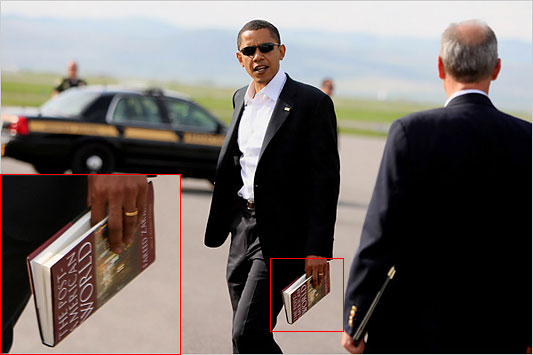
A friend forwarded this letter to me (italics). It includes a photo of President Obama carrying Fareed Zakaria's book, The Post-American World. My friend is a nice guy, very smart, a successful businessman, and a military vet. It goes to show how crazy our world has gotten. I've included my reply.

The letter:

I know some of you are Democrats and some are Republicans and many of you are Independents but we all are US citizens. I am not one to throw labels about (well I do in idle conversation) but this item depicted here is but one piece of a mosaic that is impossible to ignore but we all (collectively) are looking the other way. I invite you to follow the trail that President Obama is on and the bread crumbs he is leaving behind. I fear and believe he is leading us on a path we cannot come back from if his intentions and actions are unchecked by Congress and us, the voters.

Look and read at the U.S. Constitution and you can begin to see the mosaic he is building and using our own Founding Fathers words to cover his bread crumbs.

The path to Hell is paved with good intentions. Unfortunately it is a slippery slope when the intentions are indeed evil.

A Patriot until the End,
Name

Forwarded content:

Subject: Fwd: Fw: This is important ... a must see!

LOOK AT THE BOOK IN HIS HANDS.Let's take the bugger down through the Internet... Seems the majority of the press are worshiping at his feet....Someone should put this on facebook.. If each person sends this to a minimum of twenty people on their address list, in three days, all people in The United States of America would have the message. I believe this is one proposal that really should be passed around.


THIS WILL CURDLE YOUR BLOOD AND CURL YOUR HAIR
The name of the book Obama is reading is called:

The Post-American World
, and it was written by a fellow Muslim.

"Post" America means the world After America! Please forward this picture to everyone you know, conservative or liberal. We must expose Obama's radical ideas and his intent to bring down our beloved America !


My reply:

[Name of Friend], As a fellow Christian I'm asking you to write all the people to whom you sent this and retract or correct it.

This book is by a noted commentator -- you can see him on TV every week and there's nothing anti-American about him. The author observes that the United States no longer dominates world affairs and asks how the US can thrive in such a multilateral environment.

Here's the test I'd ask you to consider. Did you check out the book or the author before you forwarded this email? If not, I'd suggest you didn't do the Christian thing. I say that as a friend, not a political enemy.

If you'd like to talk about it, my phone is 555-1212. You're a friend I admire.
Greg

Friday, April 16, 2010

Frank Luntz and Republican Dishonesty

In today's New York Times Paul Krugman unmasks what seemed obvious to me as soon as I heard Mitch McConnell's remarks yesterday. McConnell and the Republicans say they want financial reform, and they say they're going tough on the big banks; both are lies. The Republicans want to avoid financial reform at all costs, and they are working with the big banks to develop their strategy.

Here's the thing. If you watch McConnell's performance carefully, you'll see that he's basically speaking from a script. If you watch his several speeches, it's the same script over and over. Whence the script? Frank Luntz, the consultant who provides Republicans with 15-20 page "Words That Work" memos.

Here's what Luntz has to say about financial reform. Compare his points to the Republican of your choice.
  1. Acknowledge that there's a problem. People are hurt, angry, and scared. Luntz: "When addressing the crisis, never forget its impact on your audience. Above all else, never EVER minimize the pain. "
  2. Acknowledge the need for reform. Luntz: "You must acknowledge the need for reform that ensures this NEVER happens again. " (Pay attention to "never again" in McConnell's rhetoric.)
  3. Convince people that government is the greatest danger -- especially government bureaucrats. Luntz: "If there is one thing we can all agree on, it’s that the bad decisions and harmful policies by Washington bureaucrats that in many ways led to the economic crash must never be repeated."
  4. Tell people that you're against bailing out the big banks. Luntz: "Taxpayer-funded bailouts reward bad behavior. Taxpayers should not be held responsible for the failure of big business any longer. If a business is going to fail, not matter how big, let it fail." (Again, listen to McConnell, who has been meeting with the big banks and other Congressional Republicans.)
  5. Finally, oppose "lobbyist loopholes." The Republicans have been making hay out of minor exceptions for businesses like casinos and the like. (Bob Corker has already praised McConnell for calling out loopholes in the bill.)
What's the upshot? Luntz's memo reveals what the Republicans really want. They say they want reform, but they will oppose any reform measure that has any bite. They haven't offered a single contribution or proposal for financial reform.

In other words, McConnell is doing exactly the opposite of what he says he's doing. He's not seeking reform that would hold big banks responsible; he's working with the big banks to avoid reform.